
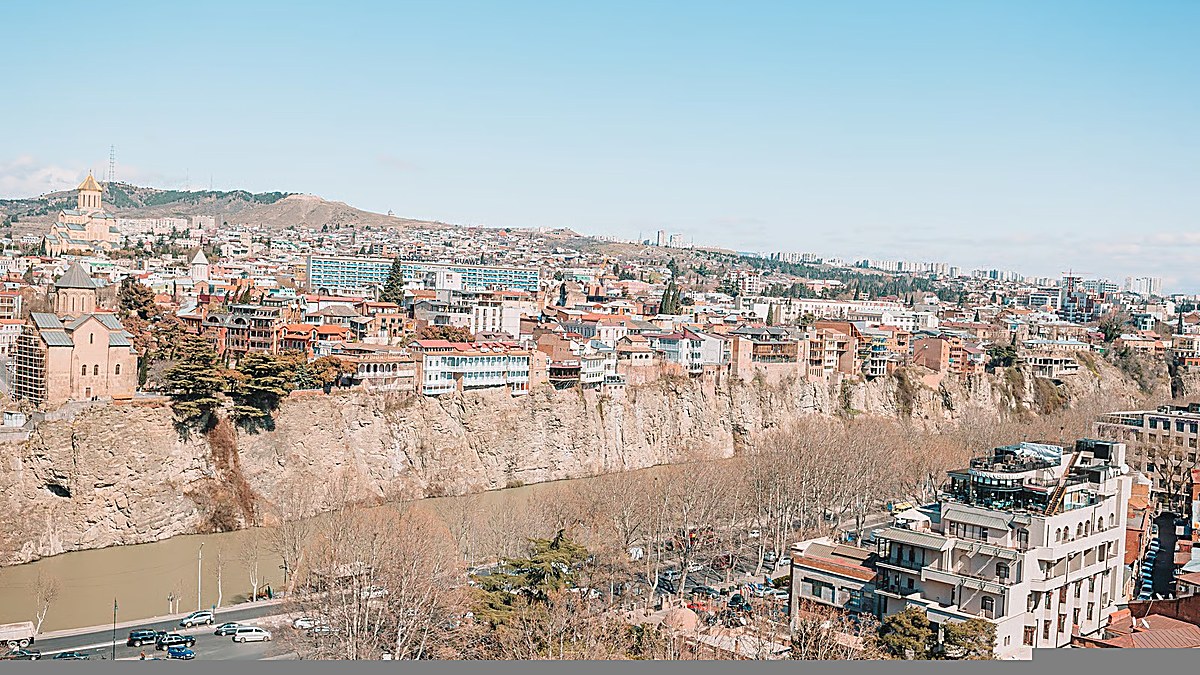
Search "study in Georgia" from Dhaka and you will find a dozen consultancy pages promising cheap medical degrees at Tbilisi State Medical University, easy visas and part-time work to cover your costs. Most of those pages were written before December 2025. Since then Georgia has changed two rules that quietly break that pitch — and almost nobody in Bangladesh has updated their page. If you are researching a Georgia student visa from Bangladesh for 2027, the honest picture is more limited than the adverts suggest, but it is still a real, workable route if you go in with your eyes open.
Bangladeshi students apply for Georgia's D3 study visa online at geoconsul.gov.ge, under the Embassy of Georgia in New Delhi, which is formally accredited to Bangladesh. The state fee is about USD 20 and the Ministry decides within 30 calendar days. From the 2026–27 academic year new foreign students can only enrol at private universities, and since 1 March 2026 a student permit alone does not allow paid work.
Can Bangladeshi students still study in Georgia in 2027?
Yes — but only at private universities. On 5 December 2025 Georgia's Minister of Education and Science, Givi Mikanadze, announced that from the next academic year foreign students will no longer be admitted to state universities, because state institutions "must be oriented toward state interests." Narrow exceptions remain for bilateral agreements, exchange programmes and specific institutional partnerships. Students already enrolled are not affected — the restriction applies to new admissions from 2026–27 onward.
This single change invalidates a large share of the Georgia marketing you will see in Bangladesh. Tbilisi State Medical University, Ilia State University and Georgian Technical University are all state institutions. Any agency page still selling you admission to those names for a 2027 intake is quoting a route that is closing. The good news is that Georgia's higher education sector is majority private — roughly 45 of its 64 accredited institutions — so there is genuine choice left.
"Is this university state-owned or private, and can it legally admit a new foreign student for the 2027 intake?" If the answer is vague, or the agent has never heard of the December 2025 announcement, that is your signal to slow down. An admission letter from an institution that cannot lawfully enrol you is worthless at the visa stage.
Where do you apply for a Georgia student visa from Bangladesh?
Here is the piece almost every competitor page gets wrong. Georgia has no visa-issuing embassy in Bangladesh. The Embassy of Georgia to the Republic of India, at 169 Jor Bagh, New Delhi, states on its own site that it is "accredited to the Kingdom of Thailand, Democratic Socialist Republic of Sri-Lanka, People's Republic of Bangladesh and Federal Democratic Republic of Nepal." That is the mission responsible for your file.
There is an Honorary Consul of Georgia in Dhaka, and this is where Bangladeshi students lose weeks. An honorary consulate is a diplomatic courtesy post — it does not process visa applications. Turning up there with your documents will not start your application.
The genuinely good news, and the reason Georgia stands out from the rest of Eduvisa's recent country research, is that there is no Delhi travel trap. Unlike the Czech, Slovak, Bulgarian and Estonian routes — where a Bangladeshi student must physically appear in New Delhi — the Georgian D3 immigration visa is filed online through the consular portal at geoconsul.gov.ge. For a student in Bangladesh that removes the single most expensive and unpredictable step in most European applications.
What documents does the D3 study visa actually require?
Georgia's Ministry of Foreign Affairs publishes a D3 document list, and it is more specific than the generic checklists circulating in Bangladesh. Two items on it are unusual and catch students out: the Order of the Minister of Education and Science regarding your acceptance, and a separate order confirming the university's accreditation and its list of English-language faculties. Neither is something you can produce yourself — your university has to supply them, and a disorganised institution will stall your file here.

| Document | Who issues it | Notes |
|---|---|---|
| Passport copy | You | Straightforward |
| Admission letter | University | Private institutions only |
| Minister's acceptance order | Ministry via university | Common delay point |
| Accreditation order | Ministry via university | Must list English faculties |
| Online entry permit | Georgian authorities | Emailed to you |
| Travel insurance | Insurer | Must cover visa validity |
| Bank statement | Your bank | Past 3 months |
| Accommodation proof | Landlord / university | Required |
| Biometric photo | You | One copy |
Verify before you apply. The most detailed D3 checklist published by Georgia's MFA is hosted by its mission in the UAE, so one line on it (a residency ID requirement) is specific to applicants living in the Emirates and does not apply to you in Bangladesh. Document lists also differ slightly between missions. Confirm your exact list with the Embassy in New Delhi at [email protected] before you assemble your file.
How much money do you actually need for Georgia?
Tuition at Georgian private universities for English-taught bachelor programmes generally runs around USD 3,000–8,000 per year, with mainstream business, computing and nursing degrees at the University of Georgia in Tbilisi published in the USD 4,000–5,000 band. At roughly ৳122 to the dollar, USD 4,000 is about ৳4.9 lakh a year — genuinely low by European standards, and a large part of why the country appeals to Bangladeshi families.
Living costs published by Ilia State University give a useful benchmark even though that institution is state-owned: accommodation around USD 200–400 per month and a meal plan near USD 120 per month. Note also that medical insurance from a Georgian insurer is obligatory for international students, so a policy bought in Bangladesh will not discharge that requirement once you are enrolled.
Now the part the agency pages will not tell you. Several Bangladeshi and Indian consultancy sites state that you must show a minimum bank balance of USD 10,000. We could not find that figure in any Georgian government source. What the MFA and the e-Visa portal actually require is proof of sufficient funds by way of a three-month bank statement, an employer's income reference, proof of real estate, or a sponsor's letter — with no published fixed minimum. A consular officer still exercises judgement, so a thin statement will hurt you. But treat any specific number you are quoted as an agency's estimate, not as Georgian law, and ask to see the source.
The refusals that hurt most are rarely about money — they are about a mismatch between the story a file tells and the documents behind it. A student whose bank statement suddenly jumps a few weeks before submission, or whose chosen programme has no link to anything they have studied before, invites questions no cover letter can answer. That is precisely the work we do sitting across a desk from you: making the file consistent before it is ever uploaded.
Can you work part-time in Georgia as a student?
This is the second rule change, and it is the one that most damages the "study and work in Georgia" pitch. Under Resolution No. 70, adopted on 20 February 2026, Georgia introduced a mandatory Special Labour Permit — a separate right-to-work authorisation — with applications opening on 1 March 2026. The critical detail for students is that the requirement applies regardless of whether the foreign national already holds a valid visa or temporary residence permit. In plain terms: your student status does not, by itself, give you the right to earn money in Georgia.
Two further details make this worse for students specifically. First, the annual quota is reported as zero for courier services, passenger transport and tourist guiding — precisely the jobs international students take. Second, there is a labour market test: an employer must advertise the role for ten working days on the state jobs portal and justify rejecting any local candidate the agency puts forward. That is a heavy process for a part-time job, and few employers will run it for a student.
Reported penalties for working without the permit run to 2,000 GEL for a first offence — roughly ৳94,000 — and the fine can fall on the worker, not only the employer. Foreign nationals already working were given until 1 January 2027 to regularise. Because this framework is new and its student-specific application is still settling, do not build your budget on part-time income.
Unconfirmed: the detailed operation of the Special Labour Permit for students — quotas, eligible sectors and how a study residence permit interacts with a work authorisation — is described mainly by Georgian law firms rather than by a single consolidated government page in English. Confirm the current position with the Embassy or a licensed Georgian adviser before making any plan that depends on working.
What changed for student residence permits on 1 September 2026?
If you take one thing from this guide that no other Bangladeshi page currently carries, take this. Amendments to Georgia's Law on the Legal Status of Aliens and Stateless Persons took effect on 1 September 2026, and they tighten what happens after you arrive. A new D6 visa category was created for minor students, while the D3 remains the adult student route with narrower renewal conditions.
The part that matters most for a Bangladeshi family is the new set of grounds on which a student's permit can be terminated:
- Failing to earn more than one-third of the maximum credits available in an academic year
- Being absent from Georgia for 183 days or more in any rolling twelve-month period
- Having student status suspended for 90 days
In other words, Georgia has moved to formal monitoring of whether a student is actually studying and actually present, and universities must now notify the migration agency when a student's status changes. Under the transitional arrangement, students whose status was suspended on 1 September 2026 have until 1 January 2027 to reinstate it, and the window to appeal a decision in court is only 10 calendar days.
Verify this one carefully. The enacted text is published in Georgian only, and our reading relies on legal analysis of the passed bill rather than an official English version. The direction of travel is not in doubt, but confirm the precise credit and absence thresholds with your university's international office before you rely on them.
Do Bangladeshi documents need apostille or embassy legalisation?
Good news here, and it is worth knowing precisely because it goes the other way for several countries we have researched recently. The 1961 Hague Apostille Convention entered into force for Bangladesh on 30 March 2025. Twelve countries formally objected to Bangladesh's accession — including Germany, Czechia, Estonia, Greece, Lithuania and others — meaning students bound for those countries still need full consular legalisation. Georgia is not among the objectors, so a Bangladeshi apostille on your certificates should be accepted, which is faster and cheaper than the old legalisation chain.
- Confirm your university is private and can admit new foreign students for 2027
- Check the programme is genuinely English-taught and on the accreditation order
- Get certificates apostilled through the Bangladesh MOFA route
- Build a clean, well-explained three-month bank statement
- Arrange accommodation proof before you submit, not after
- Budget without assuming part-time earnings
- Plan your residence permit application for immediately after arrival
What do the agency pages in Bangladesh get wrong?
We checked the live Georgia pages run by Bangladeshi consultancies while researching this guide. The recurring errors are consistent enough to be worth listing, because each one can cost you money: promoting state universities that can no longer admit new foreign students; presenting part-time work as an established student right; quoting a USD 10,000 minimum balance that no Georgian government page publishes; and implying that the Dhaka honorary consulate can process your application. A separate trap is the Georgian e-Visa. It is a short-stay tourism and business visa, never a study route — and Georgia's own e-Visa country list places Bangladesh in its most restricted category, meaning a Bangladeshi passport holder qualifies for it only while holding a valid Schengen visa, a valid OECD-country visa, or a Schengen or OECD residence permit. The widely repeated claim that Georgia is "easy e-visa access" for Bangladeshis is simply wrong.
Worth knowing before you fly: Bangladesh has no mission in Tbilisi. The Embassy of Bangladesh in Ankara, Türkiye is concurrently accredited to Georgia. If you lose your passport or need consular help, that is who you deal with — not an office in Georgia. Students routinely discover this at the worst possible moment.
Is Georgia still worth considering for 2027?
Honestly assessed: yes, for the right student. The tuition is low, the application is filed online without a trip to New Delhi, English-taught programmes exist, and the apostille route works. What has gone is the "cheap degree plus part-time job plus state medical university" package that the adverts still sell. If your family can fund the studies without counting on your earnings, and you choose a properly accredited private institution, Georgia remains one of the more accessible destinations on our research list. If your plan depends on working to survive, this is not the country for 2027, and we would rather tell you that now than after you have paid a deposit.
Related guides: Estonia student visa from Bangladesh 2027 · Bulgaria student visa from Bangladesh 2027
Official sources referenced: the Embassy of Georgia in New Delhi (accreditation to Bangladesh) and the Georgian e-Visa portal (proof-of-funds wording and fees).
Please note: this guide is blog research produced for Bangladeshi students, not a statement that Eduvisa currently processes applications to Georgia. Rules quoted were checked in September 2026 and can change without notice — confirm with the Embassy before acting.
Not sure whether Georgia fits your situation?
Every file is different — your results, your funding, your family's circumstances and your longer-term plan all change the answer. Come and sit with us, and we will go through your documents honestly, tell you where the risks are, and help you decide between Georgia and the alternatives that might suit you better.
Book Free Consultation →