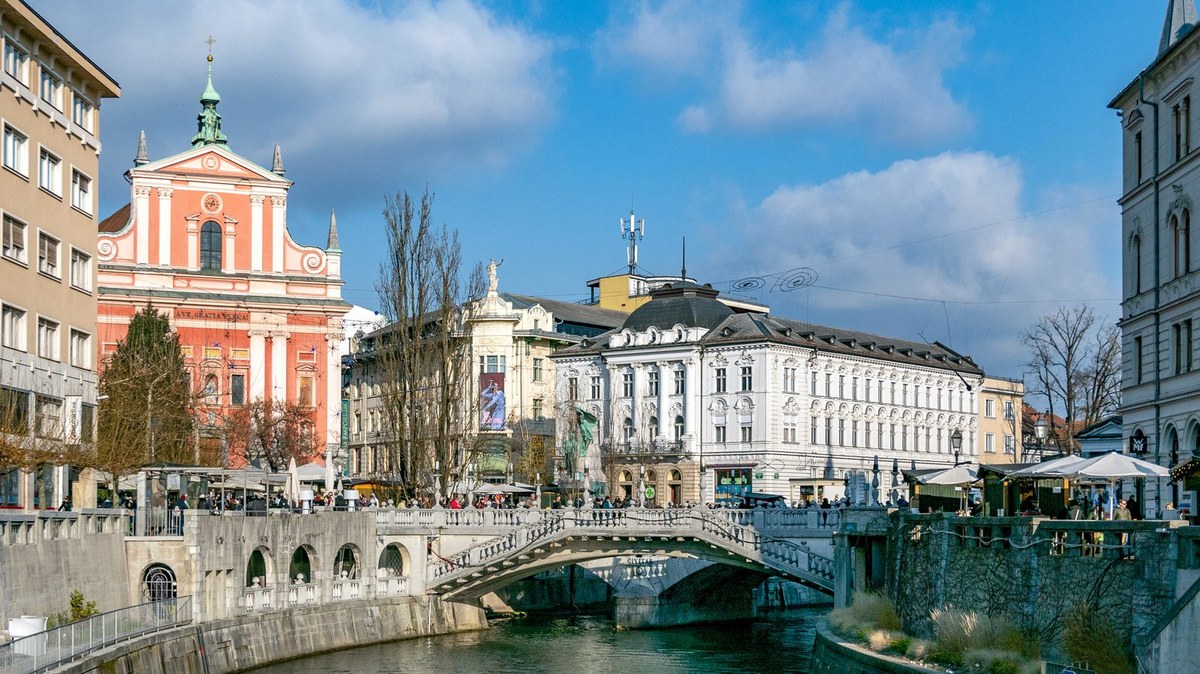
Ljubljana is a city of about 300,000 people where students cycle to lectures past a green river and a castle on a hill. It is one of the quietest, safest capitals in the European Union — and one of the least understood by Bangladeshi students, because almost nothing written about it in Bangladesh has been updated in years.
If you are researching the Slovenia student visa from Bangladesh 2027, the first thing worth knowing is that Slovenia does not decide your student file in Dhaka. It cannot. There is no Slovenian embassy in Bangladesh, and the visa centre you may have been told about handles a completely different kind of visa. That single fact changes your timeline, your budget and your travel plans — so we start there.
Slovenia has no embassy in Bangladesh. Bangladeshi students apply for a temporary residence permit for study at the Slovenian Embassy in New Delhi, which covers Bangladesh, by e-mail appointment only. The first permit application costs EUR 102 at the embassy, and you must show roughly EUR 507.43 per month in support. Public tuition ranges from about EUR 3,400 to EUR 14,700 a year depending on the faculty.
Why is the Slovenia student visa from Bangladesh different from a Schengen tourist visa?
Because for a degree, Slovenia does not issue you a visa at all — it issues a temporary residence permit, and you must hold it before you enter the country. Slovenia's Foreigners Act treats any stay over three months as residence, not travel. A Schengen "C" sticker, the kind you would get for a two-week holiday, cannot be converted into study permission after you land.
There is a second difference that catches Bangladeshi passport holders specifically, and it is not on a single consultancy page we have read. Slovenia's own foreign ministry states that for citizens of Bangladesh and Sri Lanka, a visa is required to enter an airport transit area too — the airport transit visa, type A. If your route to Europe connects through a Schengen airport and you do not yet hold your residence permit, you may need an A visa simply to sit in the transit lounge. Plan your ticket around this, not after it.
Slovenia is represented in Bangladesh by the Embassy of Sweden in Dhaka — but only for short-stay Schengen (C) visas. No study file is decided there. If an agent tells you your Slovenia student application can be completed in Dhaka, ask them which office issues the residence permit. The answer is New Delhi.
Where do you apply — and why can't you use the Dhaka visa centre?
You apply at the Embassy of the Republic of Slovenia in New Delhi, Block C-36, Anand Niketan, 110021. Its consular district covers India, Bangladesh, Bhutan, the Maldives, Nepal and Sri Lanka. There is no walk-in counter and no VFS route for Bangladeshi students — VFS Global centres in India serve Indian applicants.
Appointments are arranged by e-mail only. You write to [email protected] with five things: name, surname, date of birth, passport number and the service you need. The consular section works Monday to Friday, 10:00–13:00, with an extra Wednesday slot from 15:00 to 16:00.
Two practical details that trip people up. First, the consular and visa office conducts business in Slovene, English, Hindi and Tamil only — anything in Bangla needs a translation you supply. Second, the embassy does not handle cash at all. Fees are paid by UPI (Indian rupees only) or bank transfer, in euros or rupees. A Bangladeshi student arriving in Delhi with cash in an envelope will be turned away.
There is an alternative worth understanding, because it is cheaper. Slovenia's rules allow a residence permit application to be lodged at an Administrative Unit inside Slovenia — and the embassy itself openly encourages this, urging that permit applications be submitted by an authorised person in Slovenia directly to the administrative unit. That route is only open to people who can enter Slovenia legally first, which most Bangladeshi students cannot do without a visa. But if your university or a relative in Slovenia can act for you, the fee difference is real.
| Cost item | Via New Delhi | Inside Slovenia |
|---|---|---|
| Permit application | €102.00 | €50.00 |
| Admin fee | — | €4.50 |
| Permit card | €15.00 | €15.47 |
| Delivery outside Europe | €13.00 | — |
| Total | ≈ €130 | ≈ €70 |
| Travel needed | Delhi, in person | Must already be in Slovenia |
At roughly ৳142 to the euro, the Delhi route runs about ৳18,500 in official fees alone — before your flight to Delhi, your Indian visa, and your stay there.
How much does tuition actually cost at a Slovenian public university?
This is where most guides written for Bangladeshi students go badly wrong, and where the honest answer is genuinely useful. Slovenia is often sold as "free" or "almost free." For a Bangladeshi student it is neither — but it can still be cheap, depending entirely on which subject you pick.
The University of Ljubljana waives tuition for Slovenians, EU/EEA and Swiss citizens, and for students from five countries Slovenia holds bilateral agreements with: Bosnia and Herzegovina, North Macedonia, Montenegro, Kosovo and Serbia. Bangladesh is not on that list. Bangladeshi students pay the published non-EU rate.

And that rate is not one number. It is set faculty by faculty, published as a PDF price list each year. Here is the 2026/2027 spread at a single university:
| Programme | Level | Per year | Approx BDT |
|---|---|---|---|
| Business & economics | Bachelor | €3,400 | ৳4.8 lakh |
| Social sciences | Bachelor | €4,000 | ৳5.7 lakh |
| Economics masters | Master | €4,700 | ৳6.7 lakh |
| Computer science | Bachelor | €11,000 | ৳15.6 lakh |
| Computer science | Master | €14,700 | ৳20.9 lakh |
Read that again: at the same institution, in the same year, computer science costs more than three times what business costs. Any agent quoting you "tuition in Slovenia is around €4,000" is quoting the cheap end and hoping you do not ask about your own subject.
Look at the language column on those price lists and a pattern appears: the inexpensive bachelor programmes are overwhelmingly taught in Slovene. English-taught options cluster in masters programmes and in a handful of joint degrees. So the cheapest Slovenian degree is often not a degree you can actually sit in. Check the language of instruction on the official price list for your exact programme before you fall in love with a number.
How much money do you need for a Slovenia student visa from Bangladesh?
Slovenia sets a monthly minimum rather than a lump sum. For 2026 the figure published by the University of Ljubljana is EUR 507.43 per month — roughly ৳72,000. Across a twelve-month academic year that is about EUR 6,089, or ৳8.65 lakh.
What makes Slovenia unusual, and unusually kind to a middle-income Bangladeshi family, is how you prove it. A written declaration from a parent or legal guardian, stating they will support you at no less than that monthly amount for the academic year, is accepted. One parent's signature is enough. It does not require special notarisation — it simply has to be written in English or Slovene. A bank balance, a scholarship, income from property, or funds in an account abroad are all listed as acceptable alternatives.
Compare that with destinations that demand a blocked account or six months of seasoned bank statements, and Slovenia's financial bar is one of the lightest in Europe. That is a genuine advantage, and it is worth knowing before you rule the country out.
Which documents does Slovenia ask a Bangladeshi student for?
The core list is short, but two items need Bangladesh-specific handling.
- Signed application form and separate signature form
- Passport valid well beyond your stay, plus a certified photocopy
- Biometric photo, 35 × 45 mm
- Two fingerprints, taken at the embassy or administrative unit
- Proof of enrolment from your Slovenian institution
- Proof of valid health insurance in Slovenia
- Police clearance certificate, under three months old, officially translated into Slovene
- Proof of funds — parental declaration, bank statement or scholarship letter
The University of Ljubljana's own checklist says the police clearance certificate must be translated into Slovene and, where applicable, apostilled or certified. The Apostille Convention entered into force for Bangladesh on 30 March 2025, and Slovenia is not among the countries that objected to Bangladesh's accession. That means the single-step apostille is available to you here — unlike Austria, Greece, France, Germany or Lithuania, where Bangladeshi students still face full consular legalisation.
Two more details that quietly cause refusals. Your passport validity is checked every year: because the student permit is normally issued until 30 September of the following year, your passport needs validity until roughly the end of December of that following year. And since the EU's Entry/Exit System began replacing passport stamps, you will no longer get a stamp on arrival — yet your date of entry still matters for the permit. Keep the slip you receive after your photo and fingerprints, and keep your boarding pass.
Can you work while studying in Slovenia?
Slovenia has a well-developed student work system called študentsko delo, run through agencies known as Student Services. You order a referral form, the napotnica, and that is the legal basis for the job. To enrol with an agency you need an ID, a Slovenian bank account, a Slovenian tax number and a certificate of enrolment.
Here is where we will not oversell it. The official Study in Slovenia portal describes foreign-student eligibility in terms of students "living in Slovenia through international exchange programmes." It does not clearly state the position of a degree-seeking non-EU student. We could not resolve that from the published wording, so treat your own work rights as something to confirm with your faculty's international office in writing before you rely on the income.
Foreign students working through a Student Service have 22.5% deducted from every payment as an income-tax prepayment, plus 15.5% toward pension and disability insurance. The 22.5% is refundable — but only for students from a country holding a double taxation treaty with Slovenia. Bangladesh's published treaty list of roughly 36 countries does not include Slovenia, and Slovenia's list does not include Bangladesh. On the face of it, a Bangladeshi student cannot reclaim that 22.5%. Confirm with Slovenia's Financial Administration before budgeting around part-time earnings.
Verify before you rely on this: the official portal still quotes a minimum student hourly rate of €7.21 gross, a figure that dates back to older guidance and has almost certainly risen. We are not repeating it as a current wage. Ask the Student Service agency for the rate in force when you arrive.
What happens after you graduate?
Slovenia offers a job-seeking residence permit valid for nine months. It is open to graduates of Slovenian institutions who already hold a residence permit at the time they apply, and who are within two years of completing their studies. It is issued once, for nine months, with no right of extension.
Nine months is shorter than the UK's Graduate Route or Spain's two-year window, and it is not a work permit in itself — it is time to find an employer who will then sponsor a single residence-and-work permit. Recent amendments to Slovenia's foreign-employment law have lengthened initial single permits from one year to two, with renewals up to three, so the pathway beyond the job search has genuinely improved. But nine months is a real deadline, and students who start job-hunting in their final semester do far better than those who start after graduation.
What do most Bangladeshi applicants get wrong about the timeline?
They assume they can enrol in September and start in October. The University of Ljubljana says otherwise, and says it plainly: if you need a visa, you should apply three to six months before your planned arrival, and because enrolment itself takes place in September, you will probably not be able to begin your studies in October. You will be obtaining the permit through the embassy while term is already running.
In practice that means a Bangladeshi student targeting the 2027/2028 academic year should be working backwards from a Delhi appointment in spring 2027, not scrambling in August. Remember the permit is normally valid only until 30 September of the following year, and a renewal must be submitted before it expires — miss that date and you do not renew, you start the whole first-time procedure again.
What we see at Eduvisa is that the destinations where Bangladeshi students lose an intake are rarely the hard ones. They are the ones where a single administrative step sits in another country and nobody flagged it early enough. Slovenia is exactly that kind of destination: the requirements are modest, the money bar is low, and the thing that costs students a year is the Delhi appointment they booked two months too late.
Sources age fast, and some already have. Every figure above comes from Slovenian government or University of Ljubljana pages current in September 2026. Fees, the monthly funds figure and appointment procedure change without notice. Confirm directly with the Embassy of Slovenia in New Delhi and your chosen faculty before you act on anything here. For context on how stale the competing information is: one well-known Dhaka consultancy's Slovenia page still names Borut Pahor as President and Janez Janša as Prime Minister, and states its information was "valid until 31 December, 2021."
This post is blog research for Bangladeshi students, not a statement that Eduvisa currently processes Slovenia applications. Our processing countries are listed on our services pages.
Related guides: Austria student visa from Bangladesh 2027 · Croatia student visa from Bangladesh 2027
Official sources: Visa information, Embassy of Slovenia in New Delhi (gov.si) · Temporary residence permit for studies, University of Ljubljana
Not sure whether Slovenia fits your subject and your budget?
That is the honest question here, and it is not one a blog post can answer for you. Whether Slovenia works depends on your exact programme, whether it is taught in English, what your family can document, and how your timeline lines up with a Delhi appointment. Sit down with us and we will go through your papers properly — no charge, no pressure, and a straight answer even when the answer is "look somewhere else."
Book Free Consultation →